
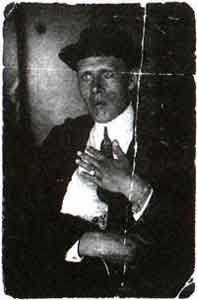
 We now return to Daniil Kharms (1905-1942): a non-person for much of the Stalin-Khrushchev period of Soviet Russia. The first selection of Kharms's work in Russia came only in 1988, amid glasnost, while the first collection in English – Russia’s Lost Literature of the Absurd – appeared in 1971. Recently, there has been a relative Kharms glut, beyond the reprinting of my selection of his work, Incidences. Collections have been published by Eugene Ostashevsky (OBERIU: An Anthology of Russian Absurdism) and Matvei Yankelevich (Today I Wrote Nothing). More recently, Kharmsian ballets, operas (notably the “music dramas” of Haflidi Hallgrimsson; plus Simon Callow’s reading of “Mini-Stories” to Hallgrimsson’s music), theatricals and so on, whether in Russia or the West, have become almost commonplace – at least within certain niche circles. There has even been talk of a BBC documentary. In the present age of postmodernist fragmentation, Kharms’s time has surely come.
If Kharms seems different from previous absurdist models, or somehow more startling, this may be explicable through his constant adoption of a poetics of extremism. Take, for example, his brevity: not for nothing did he note in his diary: “garrulity is the mother of mediocrity”. If certain “stories” seem microtexts of concise inconsequentiality, others incommode the printer even less: consider the following “complete” story:
An old man was scratching his head with both hands. In places where he couldn’t reach with both hands, he scratched himself with one, but very, very, fast. And while he was doing it he blinked rapidly.Another “extreme” feature is Kharms’s uncompromising quest for the means to undermine his own writings, or to facilitate their self-destruction. He turns a surgical glance on the extraordinary world of Stalin’s Russia and on representation, past and present, in storytelling and other artistic forms. He operates, typically, against a precise Leningrad background, reflecting aspects of Soviet life and literary forms, passing sardonic and despairing comment on the period in which he lived. He also ventures, ludicrously, into historical areas, parodying the ways in which respected worthies (Pushkin, Gogol and Ivan Susanin) were glorified in print. Yet Kharms’s miniatures can seem strangely anticipatory of more modern trends, reflecting almost a politically correct America, or London’s cardboard city; one extract, “On an Approach to Immortality”, would surely fascinate Milan Kundera.
The most striking feature, for many, is the recurrence of Kharms’s strange and disturbing obsessions: with falling, accidents, chance, sudden death, victimization and apparently mindless violence. Frequently there appears little or no difference between his avowedly fictional works and his other writings. In his notebooks can be found such passages as:
I don’t like children, old men, old women, and the reasonable middle aged. To poison children, that would be harsh. But, hell, something needs to be done with them!...How far into the cheek the tongue may go is far from clear: the degree of narratorial identification remains problematic. The better known Kharmsian obsessions, too (such as falling), carry over into his notebooks and diaries:
I respect only young, robust and splendiferous women. The remaining representatives of the human race I regard suspiciously. Old women who are repositories of reasonable ideas ought to be lassoed...
Which is the more agreeable sight: an old woman clad in just a shift, or a young man completely naked? And which, in that state, is the less permissible in public?...
What's so great about flowers? You get a significantly better smell from between women’s legs. Both are pure nature, so no one dare be outraged at my words.
On falling into filth, there is only one thing for a man to do: just fall, without looking round. The important thing is just to do this with style and energy.The implications can seem particularly sinister, as in this note from 1940, which could equally be a sketch for a story, or even, as we have seen, a “mini-story” in itself:
One man was pursuing another when the latter, who was running away, in his turn, pursued a third man who, not sensing the chase behind him, was simply walking at a brisk pace along the pavement.Other entries rather more predictably affirm what might be supposed to be his philosophy:
I am interested only in ‘nonsense’; only in that which makes no practical sense. I am interested in life only in its absurd manifestation.This last, apparently frivolous, remark was written in 1937, at the height of Stalin's purges.
All this may be approached through the propositions of the absurd outlined above, or indeed by reference to the nature of the surrounding reality: in times of extremity, it is the times themselves which may seem more absurd than any artistic invention. For that matter, Kharmsian “incidents” (and “incidences”, “happenings” or “cases” – all possible translations of sluchai) have their ancestry in a multitude of genres and models: fable, parable, fairytale, children’s story, philosophical or dramatic dialogue, comic monologue, carnival, cartoon and silent movie – even the video-nasty. All seem present somewhere in Kharms, in compressed form and devoid of explanation, context and other standard trappings. Kharms, indeed, seems to serve up, transform or abort the bare bones of the sub-plots, plot segments and timeless authorial devices of world literature, from the narratives of antiquity to classic European fiction and the wordplay, plot-play and metafictions of our postmodern era. Kharms offers a skeletal terseness, in opposition to the comprehensive vacuousness of many more conventional literary forms.
As well as translating selections from the writings of Daniil Kharms (see above) and Mayakovsky’s My Discovery of America (Hesperus, 2005), Neil Cornwell is author of The Absurd in Literature (Manchester UP, 2006) and editor of Daniil Kharms and the Poetics of the Absurd (Macmillan, 1991). He is also Russian editor for the online Literary Encyclopedia. This article is the last of a three-part series.
