I guest edited Blake Butler’s Lamination Colony and the issue looks amazing. Blake asked me what I wanted it to look like and then he made it look like that. It’s all different-colored boxes that you have to scroll over until a name pops up and then you click on that some-colored box and there is something for you to love there.
There are 100 boxes and 38 writers and over 60 pieces. There is Kim Chinquee, Adam Robinson, Ben Mirov, DS White, Matthew Salesses, Blaster Al Ackerman, M.T. Fallon, Adam Good, Stephanie Barber, J.A. Tyler, Catherine Moran, Cooper Renner, Luca Dipierro, Amanda Raczkowski, Rupert Wondolowski, Whitney Woolf, Lauren Becker, Michael Bible, Robert Swartwood, Darcelle Bleau, Robert Bradley, Jamie Gaughran-Perez, Aimee Lynn-Hirschowitz, Shane Jones, Conor Madigan, Krammer Abrahams, Shatera Davenport, Jordan Sanderson, Stacie Leatherman, Josh Maday, Joseph Young, Jason Jones, Gena Mohwish, Jen Michalski, Aby Kaupang, Jac Jemc, Karen Lillis, and Justin Sirois.

Tuesday, 31 March 2009

The Absurd in Prose Fiction - Part III: Daniil Kharms
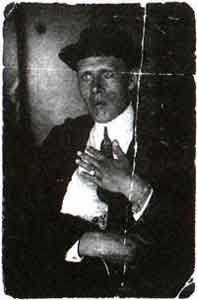 We now return to Daniil Kharms (1905-1942): a non-person for much of the Stalin-Khrushchev period of Soviet Russia. The first selection of Kharms's work in Russia came only in 1988, amid glasnost, while the first collection in English – Russia’s Lost Literature of the Absurd – appeared in 1971. Recently, there has been a relative Kharms glut, beyond the reprinting of my selection of his work, Incidences. Collections have been published by Eugene Ostashevsky (OBERIU: An Anthology of Russian Absurdism) and Matvei Yankelevich (Today I Wrote Nothing). More recently, Kharmsian ballets, operas (notably the “music dramas” of Haflidi Hallgrimsson; plus Simon Callow’s reading of “Mini-Stories” to Hallgrimsson’s music), theatricals and so on, whether in Russia or the West, have become almost commonplace – at least within certain niche circles. There has even been talk of a BBC documentary. In the present age of postmodernist fragmentation, Kharms’s time has surely come.
If Kharms seems different from previous absurdist models, or somehow more startling, this may be explicable through his constant adoption of a poetics of extremism. Take, for example, his brevity: not for nothing did he note in his diary: “garrulity is the mother of mediocrity”. If certain “stories” seem microtexts of concise inconsequentiality, others incommode the printer even less: consider the following “complete” story:
An old man was scratching his head with both hands. In places where he couldn’t reach with both hands, he scratched himself with one, but very, very, fast. And while he was doing it he blinked rapidly.Another “extreme” feature is Kharms’s uncompromising quest for the means to undermine his own writings, or to facilitate their self-destruction. He turns a surgical glance on the extraordinary world of Stalin’s Russia and on representation, past and present, in storytelling and other artistic forms. He operates, typically, against a precise Leningrad background, reflecting aspects of Soviet life and literary forms, passing sardonic and despairing comment on the period in which he lived. He also ventures, ludicrously, into historical areas, parodying the ways in which respected worthies (Pushkin, Gogol and Ivan Susanin) were glorified in print. Yet Kharms’s miniatures can seem strangely anticipatory of more modern trends, reflecting almost a politically correct America, or London’s cardboard city; one extract, “On an Approach to Immortality”, would surely fascinate Milan Kundera.
The most striking feature, for many, is the recurrence of Kharms’s strange and disturbing obsessions: with falling, accidents, chance, sudden death, victimization and apparently mindless violence. Frequently there appears little or no difference between his avowedly fictional works and his other writings. In his notebooks can be found such passages as:
I don’t like children, old men, old women, and the reasonable middle aged. To poison children, that would be harsh. But, hell, something needs to be done with them!...How far into the cheek the tongue may go is far from clear: the degree of narratorial identification remains problematic. The better known Kharmsian obsessions, too (such as falling), carry over into his notebooks and diaries:
I respect only young, robust and splendiferous women. The remaining representatives of the human race I regard suspiciously. Old women who are repositories of reasonable ideas ought to be lassoed...
Which is the more agreeable sight: an old woman clad in just a shift, or a young man completely naked? And which, in that state, is the less permissible in public?...
What's so great about flowers? You get a significantly better smell from between women’s legs. Both are pure nature, so no one dare be outraged at my words.
On falling into filth, there is only one thing for a man to do: just fall, without looking round. The important thing is just to do this with style and energy.The implications can seem particularly sinister, as in this note from 1940, which could equally be a sketch for a story, or even, as we have seen, a “mini-story” in itself:
One man was pursuing another when the latter, who was running away, in his turn, pursued a third man who, not sensing the chase behind him, was simply walking at a brisk pace along the pavement.Other entries rather more predictably affirm what might be supposed to be his philosophy:
I am interested only in ‘nonsense’; only in that which makes no practical sense. I am interested in life only in its absurd manifestation.This last, apparently frivolous, remark was written in 1937, at the height of Stalin's purges.
All this may be approached through the propositions of the absurd outlined above, or indeed by reference to the nature of the surrounding reality: in times of extremity, it is the times themselves which may seem more absurd than any artistic invention. For that matter, Kharmsian “incidents” (and “incidences”, “happenings” or “cases” – all possible translations of sluchai) have their ancestry in a multitude of genres and models: fable, parable, fairytale, children’s story, philosophical or dramatic dialogue, comic monologue, carnival, cartoon and silent movie – even the video-nasty. All seem present somewhere in Kharms, in compressed form and devoid of explanation, context and other standard trappings. Kharms, indeed, seems to serve up, transform or abort the bare bones of the sub-plots, plot segments and timeless authorial devices of world literature, from the narratives of antiquity to classic European fiction and the wordplay, plot-play and metafictions of our postmodern era. Kharms offers a skeletal terseness, in opposition to the comprehensive vacuousness of many more conventional literary forms.
As well as translating selections from the writings of Daniil Kharms (see above) and Mayakovsky’s My Discovery of America (Hesperus, 2005), Neil Cornwell is author of The Absurd in Literature (Manchester UP, 2006) and editor of Daniil Kharms and the Poetics of the Absurd (Macmillan, 1991). He is also Russian editor for the online Literary Encyclopedia. This article is the last of a three-part series.
Monday, 30 March 2009
John Updike’s The Witches of Eastwick – a fast-track process
It is with great sadness that I announce to the world I have given up reading Updike’s The Witches of Eastwick on page 10. I have just seen AA’s prophetic comment on my previous blog entry, which says: “Better go straight to The Plague – or any other book by Camus, for that matter – skipping The Witches.” Here’s my verdict on the book:
Did I like the book?
It ain’t my cup of tea. Not badly written, but baroque and overwritten to the point of paroxism. Too much fluff and – I can’t figure out what the heck is happening. I read the first ten pages three times, during three separate sessions. I give up.
What did I like most?
Er, the editing and the production, for once. . .
What didn’t work for me?
Just as for Sinclair Lewis, the prose seems to grow in a sort of tumorous way rather than flow naturally.
Would I publish it?
No. I loved the man when he was alive, and now I feel slightly guilty because I don’t like his work now that he’s gone. I am sorry, but even if many consider him one of the finest writers in the great American tradition, this book – for me – reads like the ichthyological parts of Moby Dick.
What if it came as an unsolicited manuscript?
I would pass.
Did it sustain my interest throughout?
Giving up on page 10 is not a good sign.
The best bit in the book?
I read too little to find one.
The best scene in the book?
Ditto.
Comments on the package, editing, typesetting?
After the nasty comments I have made in the past about other Penguin Classics titles, I must admit that this book, both for editorial care and quality of typography, package etc. is refreshingly good. I think the new Penguin Classics are miles better than the old ones in terms of quality. It’s a good sign.
My final verdict?
I’ll probably pick up another Updike book some time – possibly one from the celebrated Rabbit trilogy. But I am in no particular rush.
The next book I’m going to try will either be a Ionesco play or a Céline novel. More soon.
AG
Did I like the book?
It ain’t my cup of tea. Not badly written, but baroque and overwritten to the point of paroxism. Too much fluff and – I can’t figure out what the heck is happening. I read the first ten pages three times, during three separate sessions. I give up.
What did I like most?
Er, the editing and the production, for once. . .
What didn’t work for me?
Just as for Sinclair Lewis, the prose seems to grow in a sort of tumorous way rather than flow naturally.
Would I publish it?
No. I loved the man when he was alive, and now I feel slightly guilty because I don’t like his work now that he’s gone. I am sorry, but even if many consider him one of the finest writers in the great American tradition, this book – for me – reads like the ichthyological parts of Moby Dick.
What if it came as an unsolicited manuscript?
I would pass.
Did it sustain my interest throughout?
Giving up on page 10 is not a good sign.
The best bit in the book?
I read too little to find one.
The best scene in the book?
Ditto.
Comments on the package, editing, typesetting?
After the nasty comments I have made in the past about other Penguin Classics titles, I must admit that this book, both for editorial care and quality of typography, package etc. is refreshingly good. I think the new Penguin Classics are miles better than the old ones in terms of quality. It’s a good sign.
My final verdict?
I’ll probably pick up another Updike book some time – possibly one from the celebrated Rabbit trilogy. But I am in no particular rush.
The next book I’m going to try will either be a Ionesco play or a Céline novel. More soon.
AG
Saturday, 28 March 2009
The Outsider by Albert Camus – the jury is in
I remember reading Camus’s Caligula a few years ago and being very impressed. I have now decided to try one of his celebrated short novels and see if it lived up to its reputation.
Did I like the book?
Yes, I think it’s a masterly work. It gets the reader straight into the story – great characterization, great scenes. Oddly funny at times.
What did I like most?
The unpretentiousness of the style, and the ease in which the existentialist themes are weaved into the storyline. The narrator’s voice, and consequently the story, is very believable.
What didn’t work for me?
The translation is generally good, but there are quite a few oddities – mostly concerning the choice of words. It’s a shame I don’t have the French text to hand, as I’d have liked to check the translation against the original. I think I spotted a handful of mistakes.
Would I publish it?
Without a doubt. If there’s a publisher in UK who could do a better job than Penguin, that would be – ahem – us: it would just fit nicely with the rest of our French classics list (Céline, Artaud, Ionesco, Duras, Robbe-Grillet etc.). I hope I can hang in there until it comes out of copyright on 1st January 2031. I’ll make a note on my diary.
What if it came as an unsolicited manuscript?
I would call an extraordinary publishing meeting and start getting printers’ quotes.
Did it sustain my interest throughout?
Yes, from beginning to end. Everything is in the balance to the very last paragraph.
The best bit in the book?
Probably towards the end, when the narrator is in his cell and as the priest is trying to make him turn to religious thoughts he says: “I went up to him and made one last attempt to explain to him that I didn’t have much time left. I didn’t want to waste it on God.” How can you beat that last sentence?
The best scene in the book?
There are many. The funeral, the killing, the process. But what I liked most is how Camus managed to bring alive the characters in the book – Raymond and old dog-beating neighbour – with a few light touches and bits of dialogue.
Comments on the package, editing, typesetting?
Ora veniamo alle dolenti note. This Penguin Modern Classics edition – which appears to have been acquired by the Kew Library towards the end of 2002 – is falling apart. It was taken out for the first time on 3rd December 2002 and the librarian scribbled the following note on the 22nd November 2008: “Spine noted”. From this I gather that a Penguin Modern Classics spine is made to last around six years or twenty-two reads (I counted the date stamps). Perhaps some sort of obsolescence is built in it, as in my watch strap. The paper seems to suffer from jaundice, and it’s full of strange yellow and brown stains. I think the paper’s dying. I haven’t spotted any typos, but there’s lots of in-house decisions that are questionable (for example: “he’d talked to me about mother” – surely it should be “Mother”?), and missing or misplaced commas, missing hyphens etc. What I would call a lazy editorial job, in short – especially for a book which is only around 100 pages long.
My final verdict?
A great read, a classic. Lucky Penguin for having it in their list. I want to read more Camus soon. But the next book on my desk is Updike’s The Witches of Eastwick, so I’ll report on that one as and when.
AG
Did I like the book?
Yes, I think it’s a masterly work. It gets the reader straight into the story – great characterization, great scenes. Oddly funny at times.
What did I like most?
The unpretentiousness of the style, and the ease in which the existentialist themes are weaved into the storyline. The narrator’s voice, and consequently the story, is very believable.
What didn’t work for me?
The translation is generally good, but there are quite a few oddities – mostly concerning the choice of words. It’s a shame I don’t have the French text to hand, as I’d have liked to check the translation against the original. I think I spotted a handful of mistakes.
Would I publish it?
Without a doubt. If there’s a publisher in UK who could do a better job than Penguin, that would be – ahem – us: it would just fit nicely with the rest of our French classics list (Céline, Artaud, Ionesco, Duras, Robbe-Grillet etc.). I hope I can hang in there until it comes out of copyright on 1st January 2031. I’ll make a note on my diary.
What if it came as an unsolicited manuscript?
I would call an extraordinary publishing meeting and start getting printers’ quotes.
Did it sustain my interest throughout?
Yes, from beginning to end. Everything is in the balance to the very last paragraph.
The best bit in the book?
Probably towards the end, when the narrator is in his cell and as the priest is trying to make him turn to religious thoughts he says: “I went up to him and made one last attempt to explain to him that I didn’t have much time left. I didn’t want to waste it on God.” How can you beat that last sentence?
The best scene in the book?
There are many. The funeral, the killing, the process. But what I liked most is how Camus managed to bring alive the characters in the book – Raymond and old dog-beating neighbour – with a few light touches and bits of dialogue.
Comments on the package, editing, typesetting?
Ora veniamo alle dolenti note. This Penguin Modern Classics edition – which appears to have been acquired by the Kew Library towards the end of 2002 – is falling apart. It was taken out for the first time on 3rd December 2002 and the librarian scribbled the following note on the 22nd November 2008: “Spine noted”. From this I gather that a Penguin Modern Classics spine is made to last around six years or twenty-two reads (I counted the date stamps). Perhaps some sort of obsolescence is built in it, as in my watch strap. The paper seems to suffer from jaundice, and it’s full of strange yellow and brown stains. I think the paper’s dying. I haven’t spotted any typos, but there’s lots of in-house decisions that are questionable (for example: “he’d talked to me about mother” – surely it should be “Mother”?), and missing or misplaced commas, missing hyphens etc. What I would call a lazy editorial job, in short – especially for a book which is only around 100 pages long.
My final verdict?
A great read, a classic. Lucky Penguin for having it in their list. I want to read more Camus soon. But the next book on my desk is Updike’s The Witches of Eastwick, so I’ll report on that one as and when.
AG
Friday, 27 March 2009
“Fair Play is Foul and Foul Play is Fair”
This is, in a nutshell, what is happening in British publishing today.
Yesterday I went to one of the loveliest parties in years, to celebrate Capuchin Classics’ first birthday. Capuchin Classics, for the few of you who don’t know, is a great independent run by Hugh Grant’s younger and posher brother, who is known to the publishing community by the name of Max Scott. Their motto is “Books to keep alive”.
The venue was the company’s headquarters in Notting Hill, next door to Lucian Freud, I am told. As I have reported in a previous blog, all the antiques and works of art scattered casually in every nook and cranny of the house are properly insured.
This party was great because I didn’t see many of the obnoxious faces you bump into at other parties, and because I met a few interesting people, including two of Capuchin’s crusading editors – Emma and Christopher. The latter surprised the audience at one point with what must go down in history as one of the most politely controversial speeches in publishing history. I have been allowed to report it verbatim, as it’s a kind of press release:
“Interestingly, it was John Milton who, way back when the book was still, literally, fairly novel, observed that 'Books are not absolutely dead things, but contain a potency of life in them to be as active as that soul whose progeny they are.'
That sense of a legacy, then, is ever-present in today’s publishing industry. Or at least it should be. Those houses publishing in this tradition are relatively few in number – a couple are here tonight. Their books are published in the same spirit – that, literally, of making public. The view is on the long-term sales, and reaching every possible outlet.
Last year a new imprint launched, protégé of Faber and Faber, no less, which seeks not so much to put books before a browsing, buying public as to snuffle up authors’ estates from across the cannon.
We see this as a force against that tradition of a legacy. Sure, it keeps the book in print, but in the narrow sense of the term. The majority on that particular list are simply put out 'print on demand'. (The POD formula being, of course: chap walks into shop, orders a copy of Lucky Jim, book gets printed). While there are concessions for living authors (in the form of a release clause should a rival publisher put in an offer), this model is in our view lazy publishing, and short-sighted at best.
Our book-buyer had to know that Lucky Jim existed in the first place. After all, the fundamental truth remains that you cannot ask for what you do not already know exists – a law that applies as much to bookshops as it does in the land of Google. It is not, then, truly making public.
‘Foul play’, I hear you cry – and you’d be right. For this surely marks a step away from what it is to publish, and what it means to keep books alive. To the agents among you I would urge caution before conceding an author’s works to what is admittedly a prestigious name, but one that arguably undermines what it means, properly, to publish.”
I will only add Amen to that.
And to conclude this blog, I will say that there were only a couple of crazy women at this party, and that for some reason David Birkett, Capuchin’s sales director, the only working-class person – apart from me – in the house, I believe, seems to be developing a dangerous aristocratic lilt to his Londoner’s accent. I am really starting to worry about him.
AG
Yesterday I went to one of the loveliest parties in years, to celebrate Capuchin Classics’ first birthday. Capuchin Classics, for the few of you who don’t know, is a great independent run by Hugh Grant’s younger and posher brother, who is known to the publishing community by the name of Max Scott. Their motto is “Books to keep alive”.
The venue was the company’s headquarters in Notting Hill, next door to Lucian Freud, I am told. As I have reported in a previous blog, all the antiques and works of art scattered casually in every nook and cranny of the house are properly insured.
This party was great because I didn’t see many of the obnoxious faces you bump into at other parties, and because I met a few interesting people, including two of Capuchin’s crusading editors – Emma and Christopher. The latter surprised the audience at one point with what must go down in history as one of the most politely controversial speeches in publishing history. I have been allowed to report it verbatim, as it’s a kind of press release:
“Interestingly, it was John Milton who, way back when the book was still, literally, fairly novel, observed that 'Books are not absolutely dead things, but contain a potency of life in them to be as active as that soul whose progeny they are.'
That sense of a legacy, then, is ever-present in today’s publishing industry. Or at least it should be. Those houses publishing in this tradition are relatively few in number – a couple are here tonight. Their books are published in the same spirit – that, literally, of making public. The view is on the long-term sales, and reaching every possible outlet.
Last year a new imprint launched, protégé of Faber and Faber, no less, which seeks not so much to put books before a browsing, buying public as to snuffle up authors’ estates from across the cannon.
We see this as a force against that tradition of a legacy. Sure, it keeps the book in print, but in the narrow sense of the term. The majority on that particular list are simply put out 'print on demand'. (The POD formula being, of course: chap walks into shop, orders a copy of Lucky Jim, book gets printed). While there are concessions for living authors (in the form of a release clause should a rival publisher put in an offer), this model is in our view lazy publishing, and short-sighted at best.
Our book-buyer had to know that Lucky Jim existed in the first place. After all, the fundamental truth remains that you cannot ask for what you do not already know exists – a law that applies as much to bookshops as it does in the land of Google. It is not, then, truly making public.
‘Foul play’, I hear you cry – and you’d be right. For this surely marks a step away from what it is to publish, and what it means to keep books alive. To the agents among you I would urge caution before conceding an author’s works to what is admittedly a prestigious name, but one that arguably undermines what it means, properly, to publish.”
I will only add Amen to that.
And to conclude this blog, I will say that there were only a couple of crazy women at this party, and that for some reason David Birkett, Capuchin’s sales director, the only working-class person – apart from me – in the house, I believe, seems to be developing a dangerous aristocratic lilt to his Londoner’s accent. I am really starting to worry about him.
AG
Thursday, 26 March 2009
Controlling the stage...
Prospect magazine has just published an interesting article about Samuel Beckett, and the various wranglings that have ensued since Calder first published Beckett's prose in the 1950s. That Mr Calder has been one of the most important British publishers of avant-garde literature over the last 60 years is well-known: he has published works by Henry Miller, William Burroughs, and - almost - Vladimir Nabokov's Lolita - see the article in The Bookseller, I Am Legend for a little background.
The article takes issue with the apparently vice-like grip of the Beckett estate on the ways in which Beckett's plays may be performed. I find it hard to argue with the Colin Murphy that it's perhaps a bad thing that theatre rights should extend to the point of being able to stop a play being shown if it deviates too much from the text; apart from putting off first-timers to Beckett (which a poor but faithful production will do anyway), what other disadvantages are there to allowing a director full reign over his plays? Such conservatism simply seems ill-fitting to radical works like Beckett's. Now if it was Nabokov, it would be a different matter... and even he relaxed considerably to allow Kubrick the freedom he needed to make a successful film of Lolita.
All works are open to various degrees of interpretation, and if a director decides on something ludicrous (such as setting Endgame on the moon) then his or her production will be judged accordingly by the theatre-goers. We've all seen or heard of tepid productions of Shakespeare variously done in drag or decked out in conveniently affordable military gear; rattled off in thirty seconds or stretched out for three or four hours; done 'topically' to deal with animal rights, hermaphroditism and/or globilization... but these don't seem to be a reflection on the Bard's work, rather on the directors'. The essence of a great work lies in its being so open to interpretation, otherwise the critics would lay down their pens after the last word has been said and simply go to bed.
The article takes issue with the apparently vice-like grip of the Beckett estate on the ways in which Beckett's plays may be performed. I find it hard to argue with the Colin Murphy that it's perhaps a bad thing that theatre rights should extend to the point of being able to stop a play being shown if it deviates too much from the text; apart from putting off first-timers to Beckett (which a poor but faithful production will do anyway), what other disadvantages are there to allowing a director full reign over his plays? Such conservatism simply seems ill-fitting to radical works like Beckett's. Now if it was Nabokov, it would be a different matter... and even he relaxed considerably to allow Kubrick the freedom he needed to make a successful film of Lolita.
All works are open to various degrees of interpretation, and if a director decides on something ludicrous (such as setting Endgame on the moon) then his or her production will be judged accordingly by the theatre-goers. We've all seen or heard of tepid productions of Shakespeare variously done in drag or decked out in conveniently affordable military gear; rattled off in thirty seconds or stretched out for three or four hours; done 'topically' to deal with animal rights, hermaphroditism and/or globilization... but these don't seem to be a reflection on the Bard's work, rather on the directors'. The essence of a great work lies in its being so open to interpretation, otherwise the critics would lay down their pens after the last word has been said and simply go to bed.
Wednesday, 25 March 2009
The Absurd in Prose Fiction - Part II: Absurdism in the West
The term “the absurd” is applied to literature in several ways. It describes a “school” of dramatic writing (though not all care to accept it as such), in the case of “Theatre of the Absurd”. It is also considered a prominent period style – observable, approximately, over the two middle quarters of the twentieth century (stretching roughly from the end of the First World War up until, say, the 1970s). Or it may be a category with philosophical (usually Existentialist) implications – in other words, a timeless quality, which may be seen pertaining here and there throughout literary history.
A major figure of the first half of the twentieth century was Franz Kafka. Most of his work was published only after his early death in 1924 and his reputation has burgeoned ever since, to the point that adaptations and imitations of his works abound (by, among others, Harold Pinter, Steven Berkoff and Alan Bennett), and “Kafkaesque” has become an everyday adjective. His novels The Trial and The Castle, along with shorter stories (notably Metamorphosis and In the Penal Colony) have established Kafka as the unsurpassed master-purveyor of endless streams of sinister bureaucracy and the creeping encroachments of indeterminate and hostile powers. “As Gregor Samsa awoke one morning from uneasy dreams he found himself transformed in his bed into a gigantic insect” (Metamorphosis) stands as one of the most startling opening sentences in world literature. Kafka may be classed as an absurdist par excellence – one whose creative career ended a quarter of a century before the Theatre of the Absurd, as it is now recognised, had begun.
A principal representative of both absurdist prose and Theatre of the Absurd (of which he is seen as one of the founding figures) is Samuel Beckett. A writer spanning Anglo-Irish and French literature in unique fashion, Beckett was resident in Paris from the 1930s, writing in English, then in French, and subsequently in both, translating his own works both ways. His early English prose writings, notably Murphy (1938) and Watt (begun 1941; published 1953), are, in part at least, examples of what might be called “Irish grotesque”. But Watt (written in wartime France) marks a turning point in Beckett’s prose – one indeed firmly towards the absurd. The emphasis here is placed greatly on Watt’s inner world, along with the introduction of a mysterious third world – that of the house and system of Mr Knott (in and under which the protagonist spends much of the novel’s “action”). After Watt, Beckett soon began writing his prose in French (“from a desire”, he said, “to impoverish myself still further”), as well as making another switch – into first-person narrative. First Love and the three other novellas of 1946 were written almost in anticipation of the so-called “trilogy” of novels – Molloy, Malone Dies and The Unnamable. These were the works that established Beckett as an exponent of absurdist prose, retreating ever further into what have been called “skullscapes” (or “frescoes of the skull”, the term used by James Knowlson and John Pilling), alongside his rising theatrical prowess. Beckett’s next fiction, Texts for Nothing, confirms the progression towards constriction and the minimal – a self-styled “farrago of silence and words”, engaged in “panting towards the grand apnoea” of negativity. Of his subsequent prose, let’s mention just The Lost Ones, in which Beckett creates a horrific and entropic mini-universe, the enclosed space of a flattened cylinder, inhabited by 200 people engaged in a hopeless “quest” for an exit. The observation that “in this old abode all is not yet quite for the best” stands as one of absurdist literature’s great understatements.
Another Irishman making a significant contribution to absurd prose was Flann O’Brien (the novelistic pen name of Brian O’Nolan: 1911-1966). A famed Irish Times columnist, O'Brien wrote the novel The Poor Mouth (1941) in Irish, his first language, but is now mainly remembered for two remarkable experimental and absurdist novels: At Swim-Two Birds and The Third Policeman. The main feature of the former – its stylistic and generic variations apart – is the presence of a novel within the novel, and the takeover of the inner novel’s writing by its characters, who exact revenge upon their author. The Third Policeman, suppressed by its author during his lifetime (or, rather, just left lying about), is O’Brien’s masterpiece. Here complexity of form is equalled, or even excelled, by that of a content having a strongly disturbing effect on many readers (including reportedly O’Brien himself). The plot involves murder and a hellish and apparently circular afterlife, in which the narrator is tormented by absurd policemen in a supernatural zone called “The Parish”.
In America, two notable novels of the absurd are J.P. Donleavy’s The Ginger Man (1955) and Joseph Heller’s Catch-22 (1961). Donleavy uses a mainly (all but infernal) Dublin setting of chaos and absurdity, largely created by the protagonist, Sebastian Dangerfield – the anglicized-hibernicized American antihero and mock-Christ figure. Catch-22 is dominated by a bureaucratic-military absurd, represented emblematically by the title, which is, of course, itself now more than a catch phrase. Set in the World War Two “theatre” of Italy, this novel was influential during the Vietnam War period, and takes on a renewed significance with the Gulf wars and the “War on Terrorism”.
As well as translating selections from the writings of Daniil Kharms (see above) and Mayakovsky’s My Discovery of America (Hesperus, 2005), Neil Cornwell is author of The Absurd in Literature (Manchester UP, 2006) and editor of Daniil Kharms and the Poetics of the Absurd (Macmillan, 1991). He is also Russian editor for the online Literary Encyclopedia. This article is the second of a three-part series.
A major figure of the first half of the twentieth century was Franz Kafka. Most of his work was published only after his early death in 1924 and his reputation has burgeoned ever since, to the point that adaptations and imitations of his works abound (by, among others, Harold Pinter, Steven Berkoff and Alan Bennett), and “Kafkaesque” has become an everyday adjective. His novels The Trial and The Castle, along with shorter stories (notably Metamorphosis and In the Penal Colony) have established Kafka as the unsurpassed master-purveyor of endless streams of sinister bureaucracy and the creeping encroachments of indeterminate and hostile powers. “As Gregor Samsa awoke one morning from uneasy dreams he found himself transformed in his bed into a gigantic insect” (Metamorphosis) stands as one of the most startling opening sentences in world literature. Kafka may be classed as an absurdist par excellence – one whose creative career ended a quarter of a century before the Theatre of the Absurd, as it is now recognised, had begun.
A principal representative of both absurdist prose and Theatre of the Absurd (of which he is seen as one of the founding figures) is Samuel Beckett. A writer spanning Anglo-Irish and French literature in unique fashion, Beckett was resident in Paris from the 1930s, writing in English, then in French, and subsequently in both, translating his own works both ways. His early English prose writings, notably Murphy (1938) and Watt (begun 1941; published 1953), are, in part at least, examples of what might be called “Irish grotesque”. But Watt (written in wartime France) marks a turning point in Beckett’s prose – one indeed firmly towards the absurd. The emphasis here is placed greatly on Watt’s inner world, along with the introduction of a mysterious third world – that of the house and system of Mr Knott (in and under which the protagonist spends much of the novel’s “action”). After Watt, Beckett soon began writing his prose in French (“from a desire”, he said, “to impoverish myself still further”), as well as making another switch – into first-person narrative. First Love and the three other novellas of 1946 were written almost in anticipation of the so-called “trilogy” of novels – Molloy, Malone Dies and The Unnamable. These were the works that established Beckett as an exponent of absurdist prose, retreating ever further into what have been called “skullscapes” (or “frescoes of the skull”, the term used by James Knowlson and John Pilling), alongside his rising theatrical prowess. Beckett’s next fiction, Texts for Nothing, confirms the progression towards constriction and the minimal – a self-styled “farrago of silence and words”, engaged in “panting towards the grand apnoea” of negativity. Of his subsequent prose, let’s mention just The Lost Ones, in which Beckett creates a horrific and entropic mini-universe, the enclosed space of a flattened cylinder, inhabited by 200 people engaged in a hopeless “quest” for an exit. The observation that “in this old abode all is not yet quite for the best” stands as one of absurdist literature’s great understatements.
Another Irishman making a significant contribution to absurd prose was Flann O’Brien (the novelistic pen name of Brian O’Nolan: 1911-1966). A famed Irish Times columnist, O'Brien wrote the novel The Poor Mouth (1941) in Irish, his first language, but is now mainly remembered for two remarkable experimental and absurdist novels: At Swim-Two Birds and The Third Policeman. The main feature of the former – its stylistic and generic variations apart – is the presence of a novel within the novel, and the takeover of the inner novel’s writing by its characters, who exact revenge upon their author. The Third Policeman, suppressed by its author during his lifetime (or, rather, just left lying about), is O’Brien’s masterpiece. Here complexity of form is equalled, or even excelled, by that of a content having a strongly disturbing effect on many readers (including reportedly O’Brien himself). The plot involves murder and a hellish and apparently circular afterlife, in which the narrator is tormented by absurd policemen in a supernatural zone called “The Parish”.
In America, two notable novels of the absurd are J.P. Donleavy’s The Ginger Man (1955) and Joseph Heller’s Catch-22 (1961). Donleavy uses a mainly (all but infernal) Dublin setting of chaos and absurdity, largely created by the protagonist, Sebastian Dangerfield – the anglicized-hibernicized American antihero and mock-Christ figure. Catch-22 is dominated by a bureaucratic-military absurd, represented emblematically by the title, which is, of course, itself now more than a catch phrase. Set in the World War Two “theatre” of Italy, this novel was influential during the Vietnam War period, and takes on a renewed significance with the Gulf wars and the “War on Terrorism”.
As well as translating selections from the writings of Daniil Kharms (see above) and Mayakovsky’s My Discovery of America (Hesperus, 2005), Neil Cornwell is author of The Absurd in Literature (Manchester UP, 2006) and editor of Daniil Kharms and the Poetics of the Absurd (Macmillan, 1991). He is also Russian editor for the online Literary Encyclopedia. This article is the second of a three-part series.
Subscribe to:
Posts (Atom)